Tribal Art

(Descartes and Behaviourism); he is an atomic being, an individual without any transpersonal spirit.

2. There is no essential hierarchy of being or consciousness among men or within men; even if so, it is irrelevant to knowledge and the organisation of society, governments etc.

3. Man as he is, is an imperfect being, yet the measure of all things.

c. Knowledge-Truth

1. Knowledge is an end in itself, except for the betterment of the estate of man.

2. There is one truth, if it was Christianity once, it is Science now.

3. Subject and Object can be completely separated, i.e., without a need for earlier studying oneself.

4. Reason is the only faculty by which knowledge may be obtained, even experiments are extensions of this faculty. But sensations and feelings are not true perceptions.

5. True knowledge is obtained by proceeding from the parts to the whole.

6. The importance of detaching oneself from the subject of study, rather than by participation and experiencing the object.

7. Reality is a mental construct; knowledge is abstract and general, not a vision or experience of particulars.

8. True knowledge is quantitative, not qualitative – what can be quantified is independent of place and function.

9. True knowledge leads to predictions of what is known, since it is based on external, repeatable perceptions; only that which is externalised is available to true knowledge.

10. The truth and falsity of propositions is self-evident, irrespective of the person who says it.

11. As knowledge has nothing to do with being-ness or consciousness, it is not esoteric, i.e., it requires no moral preparation to be discovered or to be understood.

12. In principle, in the making of actual observations (not in the interpretation of data), the observer can always be replaced by scientific instruments.

13. The dichotomy of faith-knowledge, is perhaps more a consequence of the Scientific Revolution rather than a presupposition that truth and knowledge reside in dimensions different from those in which religious considerations about God, etc. reside.

Thus, modern science and technology – Scientific Revolution – took place within a specific historical – philosophical climate of Western Europe during the 16th-17th centuries. These notions continue to dominate contemporary times in general. For example, the old idea of classical science continues, e.g., that of separateness: observer from the observed, man from nature, mind from matter, science from religion, etc. In short, it leads to the specialisation of different scientific disciplines that leads to competition among scientists. It was thought that the study of evolution of man, his history and archaeology, could be pursued objectively as if contemporary man was outside this picture. These reductionist explanations continue to be followed in many disciplines.

In short, the emphasis is on the localization of causes, since the sole epistemological assumption is one of empirical evidence, i.e. data arising from our physical senses. By the middle of this century these two metaphysical assumptions, of separateness and empiricism, became intrinsic to science. It is against this background that the tremendous developments, and disasters, of the 20th century need to be seen. It was sometime after World War II, that there was a great deal of assurance of humankind for the practical dimensions of the notion of ‘progress’ on a global scale, equated with high technology.

This notion of linear growth is directly related to the way one views knowledge and continues to study it, inevitably to support unexamined world views. To reterate, the study of Art whether of the past or that of “tribal” cultures, has been placed lower in the evolutionary ladder. And this is what has had Tribal Art a direct impact on contemporary situations. Without going into details, it is clear that Western thought has consistently modeled those worldviews which have generated ontological gaps that runs across the whole domain of experience. For example, human and other organisms, in spite of the fact that they share the same cosmic niche, are considered to be literally worlds apart.

This dualism is one of the fundamental, often tacit tenets of Western metaphysics, epistemology and ethics. Dualist conceptions of human beings themselves are rooted in this deep-seated anthropocentrism (Malik: 1968, 1969, 1972, 1973, 1975, 1989a, b; 1992, 1993a,b: 1995). Archaeological and culture-historical studies continue to function within this outdated paradigm, it must be stressed. This dominant worldview has even assimilated evolutionary theory, by historicising the ontological gap. All-religious or secular-teleological perspectives construe the variety of life forms as the result of a process leading to the advent of humankind.

Thus, Homo sapiens is not seen as a stage in an indefinite flux of change, but as an end, the glorious result of a history of trial and error. Is there any difference between this view and that of creationism? The dichotomy between human and nonhumans was frequently extended to other races, often treated as slaves and even women were not exactly placed in the same category as evolved humans – this was especially the case with many 19th century Darwinians. Social differences within Europe itself were classified in this line of thought, the techno-economic models supported by archaeological knowledge which we continue to take for granted (Bouissac: 1991). Again, what is considered universal today usually implies a dominant Western world view – whatever way one may define it – and all other categories have to be subsumed within it in the name of universalism. In this one may include the idea of linear time, progress towards a certain state. But this makes these approaches less flexible, as against those cultures which see evolutionary developments in terms of cyclical time wherein catastrophes are part of nature and reality and, further, are encompassed within a larger context.
Canvas painting

7 native arts of india so that it will blow your thoughts

gostops by way of gostops  march 28, 2020 in artwork, bizarre, india journey

 0  zero  0

domestic  art

art has lengthy been part of the indian culture and it is obvious from the fact that each vicinity in india has a local distinctiveness on the subject of native art/craft. Be it textile printing, paintings, handicrafts, you name it and it can be discovered in our mind-blowing united states! The rich history in the back of those artwork forms is what makes the cease product so great and welcoming. After all, a certain story associated with some thing which has been exceeded down Canvas painting from one hand to another for generations, is certain to maintain a good deal extra which means beneath its floor. India is a country which is grateful to its humans for maintaining those lengthy traditions alive in today’s times of mass manufacturing. Here’s a list of 7 indigenous artwork that can be found in india:

1. Patachitra: local art of orissa that depicts hindu epics. Patachitra – native art of orissa

photo courtesy

if we needed to literally translate patachitra, then ‘pata’ method cloth and ‘chitra’ method image/art work, therefore ‘patachitra’ means cloth artwork. It is the unique artwork form of orissa and can be dated returned to the 5th century bc. The canvas of the painting is made via masking quality gauze like fabric with tamarind paste, chalk powder and gum and then drying it. After this step, a fixed of complicated styles are drawn at the canvas and it’s miles filled with natural dyes. The forte of the patachitra artwork is the reality that they are used to depict the memories from the epics of mahabharata, ramayana and those of the local deity jagannath. The arrival of these artwork became widespread with the development of the remarkable temples of puri, konark, bhubaneshwar. 2. Cane craft: local art of north east india that dates back to second ad. Cane craft – native artwork of northeast india

picture courtesy

the northeastern part of india is thought for their unique handicrafts. The tribes of mizoram have been making the equal patterns for a long time and have become a part and parcel in their lives now. Conventional bamboo and cane craft can be considered to be a speciality of this tribe. The use of cane and bamboo is basically achieved to produce both utility and decorative items. The goods product of bamboo and canes are exceptionally durable and really fashionable. Baskets, utensils, hats, flower vases, furnishings and different ornamental objects are made out of these bamboo and cane handicrafts, which has a extensive market inside the nation and outside. Moreover, they’re very inexpensive too. Three. Gond art: nave art that brings success. Gond artwork – native arts of india

this artwork form has been advanced by the tribe of gonds in imperative india. The technique of gond artwork can be traced back to the vintage artwork of tattooing that’s not unusual many of the gonds. Nature and social customs are depicted through the gond artists with a series of dots and dashes intricately organized into forms. Their art work have been inspired via the nature that they’re surrounded with. Those art work are typically made on walls, ceilings and flooring of the houses inside the villages in honour of customs and traditions as the gonds trust their artwork to deliver them success. The artwork are a combination of earth tones and vibrant colorings, which deliver the canvas to existence. 4. Bengal pat: native art that depicts tragedies using dye product of spices. Bengal pat – native artwork of bengal

photograph courtesy

this precise art form indigenous to bengal referred to as ‘bengal pat’ is one just like orissa’s ‘patachitra’. This artwork form of bengal developed hundreds of years back while roaming minstrels used to sing approximately incidents of the remote beyond and famous lore to villagers. The dyes for the paintings are made from spices, earth, soot, and so forth. The conventional colors used in bengal pat are pink, indigo, inexperienced, black and ochre. This art form displays the existence and times of the society and folklore.

Choose a statement color. The sizable kitchen is a good asset for many home owners, but making

this space really feel intimate could be a challenge. A single way to cozy up a major kitchen is simply

by introducing a statement colour. If you have the center island, turn this into a focal stage by

painting it along with a beautiful, eye-catching colour. The island will “pull” in the walls in order to

visually create a area that feels cozier.

Comparable paint colors to try for the island and the particular walls: Aquatint and Westhighland

White from Sherwin-Williams.

Keep it bright. Obtained dirty clothes? Bhil painting Chase the particular laundry-day doldrums away within a

spacious, light-filled power room. Give this hard-working space a harmonious look by bathing the

walls and cabinets in a soft white, and select appliances which may have the exact same white tones.

If your own utility room is really a high-traffic area, go for a dark flooring. It will certainly camouflage

dirt and include depth towards the room.

Repeat a pattern. Simply by incorporating one strong design into your large room, you’ll fill the area

with “visual” texture. Maintain in mind that patterns are not limited in order to just fabrics. You may

create a vertical- or even horizontal-striped pattern with walls planks and paneling. After that bring

in window remedies and accent fabrics that echo exactly the same pattern in order to tie the

appearance together.

Add complementary colors. Making use of accent colors is the particular key to bringing character to

a large, whitened space. In a bedroom, you can incorporate colors very easily by concentrating on

the bed. By using complementary colors (hues that will are opposite one another upon the color

wheel), you’ll instantaneously create a spectacular look — particularly if a person select unexpected

colors such as moss green and candy-apple red.

Showcase your cool stuff. A single advantage to having whitened walls is that a person can

emphasize other locations and items in the area. Even in a huge room, a coat of whitened paint can

make the particular walls “disappear, ” allowing you to highlight some other interesting things, for

example colorful artwork, an amazing illumination fixture or unique home windows and woodwork.

Let your own walls become a canvas.

Go minimal. Occasionally a roomy, white room just needs to become roomy. If you want to preserve

an open up, airy feel that’s lacking of clutter, use a minimum amount of home furniture. Only pull in

the parts that you actually need. Within a home office, this particular is a good way to remove

distractions. You’ll stay focused and be more productive.

Posted onAugust 9, 2018CategoriesLiving RoomTagsabstract art, art work, large canvas artLeave a

commenton Living Large: Take Your Huge White Room to the Next Level

Proudly powered by WordPress

Paper painting

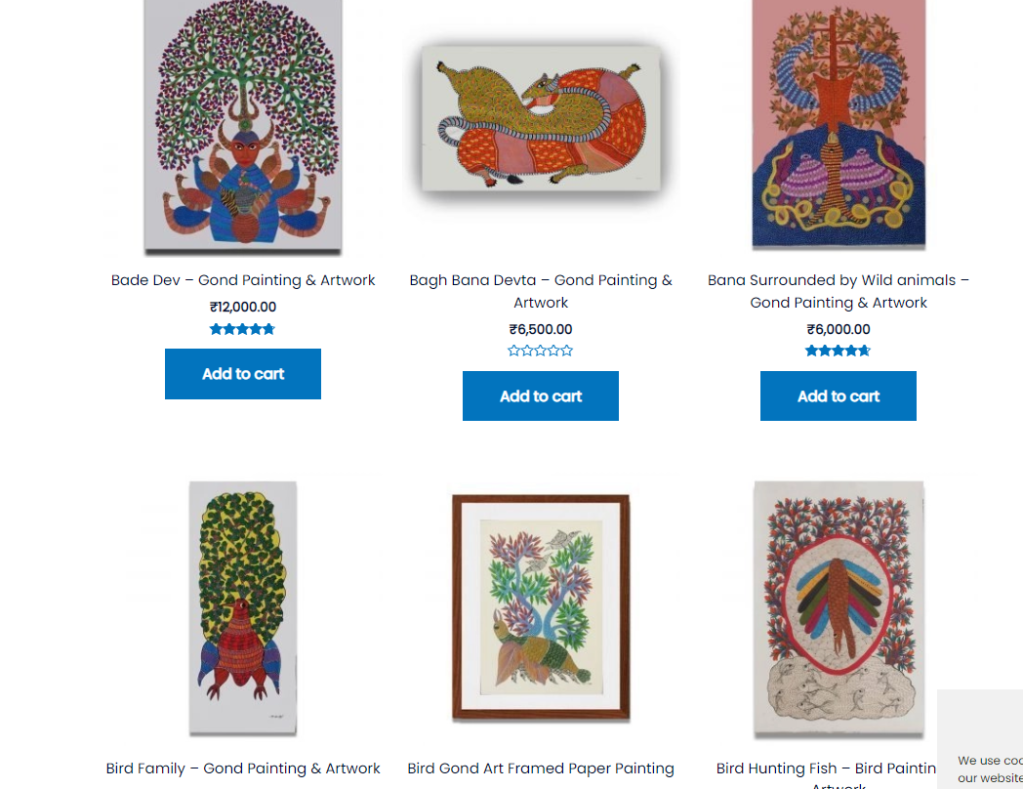
Gond Paintings – Capturing the Life and Essence of One of India's Largest Tribes

October 03, 2016by Zeina Mehal

An age-old tradition that goes back hundreds of years, tribal art in India beautifully captures the lives of some of the earliest inhabitants of our country. Among these, Gond Art – the unique art form of the Gonds, one of the largest tribes in Central India, specifically in Madhya Pradesh, truly encapsulates the essence of tribal art.

(Gond Painting; Image Source: isha.sadhguru.org)

Imaginative, vibrant and mystical, paintings by the Gonds were originally done on the walls of their homes, echoing the customs of their cave-dwelling Mesolithic forbearers. Today, many Gond artists have taken to paper and canvas, bringing one of the most exceptional and unusual art forms into the limelight, and into our hearts and homes!

(A Gond artist with a typical Gond artwork. Image source: gaatha.com)

(Traditional Gond paintings on the walls of the Tribal Museum in Kanha, Madhya Pradesh. Image source: infinityresorts.com) Like most other tribal art, Gond art is rooted in folk tales and culture. Gond paintings depict almost every aspect of the tribe's lives. Local flora, fauna, Gods and Goddesses, celebrations, festivals, folk- tales and myths are all represented through their art, making story-telling a strong element in their paintings.

(A painting by Gond artist Durga Bai)

(A painting by Bhajju Shyam, based on a Gond folktale)

Gond art is believed to be an offering in worship of nature, based on the Gond belief that a good

image ushers in good luck and helps ward off evil. The art form is characterized by an imaginative

use of lines and dots, highlighting a sense of balance and symmetry. The paintings are bright and

colourful, painted with natural colours derived from charcoal, soil, plant sap, leaves and cow dung.

(Painting by Gond artist Venkat Raman Singh Shyam)

(A Gond artwork by artist Suresh Kumar Dhurve)

Though Gond art has been around for hundreds of years, it was only in the 1980's that the art form

gained much-deserved recognition and fame, through the discovery of Jangarh Singh Shyam, a Gond

farmer and artist whose artworks received international acclaim and took him to New Delhi, New

York, Paris and Tokyo for exhibitions and shows.

(Jangarh Singh Shyam (centre) with wife Nankusiya, and Indian painter J. Swaminathan. Image source: aaa.org.hk) Shyam’s artistic brilliance was renowned. He was the first Gond artist to use acrylic on paper and Paper painting canvas for his paintings, creating the school which is now known as ‘Jangarh Kalam’. His 1988 creation, Landscape with Spider, sold for $31,250 at a 2010 Sotheby's auction, the first for an Adivasi artist.

(Landscape with Spider by Jangarh Singh Shyam, 1988. Image source: Sotheby's)

(The interiors of the Madhya Pradesh Vidhan Sabha, painted by Jangarh Singh Shyam. Image source:

jangarh-singh-shyam.blogspot.in)

Today, the late artist’s immediate and extended family members are renowned Gond artists

themselves. Though trained by Jangarh Singh Shyam, each of these artists – Nankusiya Shyam (his

wife), Japani Shyam and Mayank Shyam (his children) and other family members such as Venkat

Singh Shyam, Subhash Vyam, Bhajju Shyam and Durga Bai, have their own distinct artistic styles,

striving to keep their traditions alive.

('Swarn Hiran' by Nankusiya Shyam, wife of Jangarh Singh Shyam) (Gond painting by Jangarh Singh Shyam's daughter, Japani Shyam) (An artwork by renowned Gond artist Subhash Vyam) (Sukhnandi Vyam Pardhan, nephew of Jangarh Singh Shyam, using acrylics on canvas to create a Gond painting. Source: Mid Day) Traditional, aesthetic and mysterious, the ethos of Gond art lies in its ability to express the language of the tribe’s soul on walls, canvas or paper, making this ancient art form a true reflection of India’s rich artistic heritage.

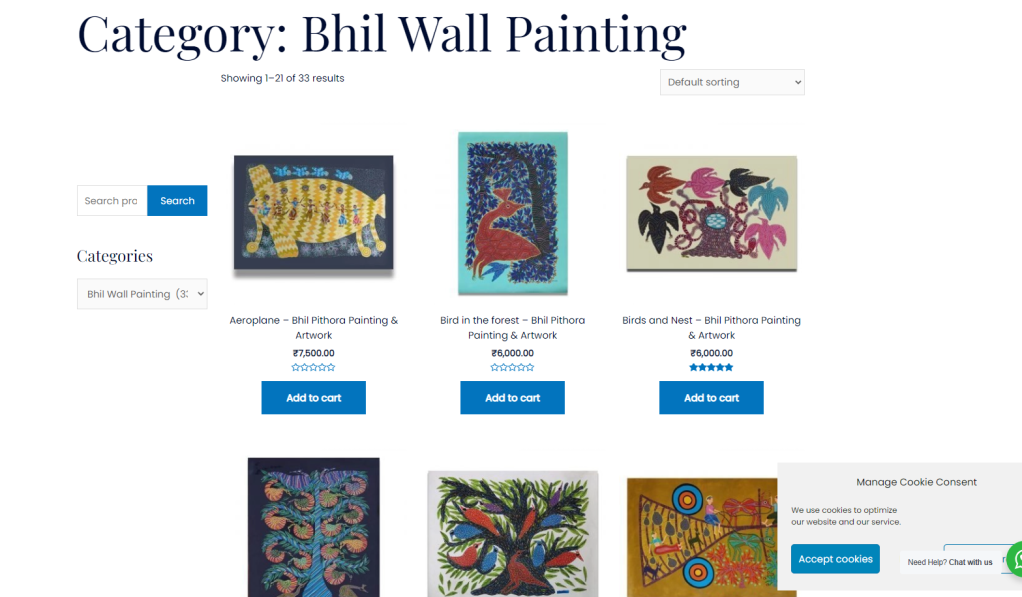
Bhil painting

The Gonds traditionally painted on mud walls of their houses. Starting in the early 1980s, certain talented Pardhan Bhil painting Gonds who traditionally serve as professional bardic priests began transforming their ritual performing arts into a new tradition of figurative and narrative visual art: using a variety of modern media (including acrylic paintings on canvas, ink drawings on paper, silkscreen prints, and animated film) they have created unprecedented depictions of their natural and mythological worlds, traditional songs and oral histories.

MADHUBANI

Madhubani, which literal translates into Forest of Honey, is a small village in northern Bihar.The origins of Madhubani (or Mithila) art are shrouded in antiquity. Tradition states that this art style dates back to mythology of the Ramayana, when King Janak commissioned artists to do paintings at the time of marriage of his daughter, Sita, to Lord Ram. However the contemporary art of Mithila painting was born in the early 1960’s, following the terrible famine in Bihar. It was Baskar Kulkarni from the All India Handicraft Board in Delhi who recognized the commercial potential of this folk art form and urged the villagers to also paint on handmade paper to supplement their meager income and alleviate the poverty of the region. Over the past fifty years a wide range of styles of Mithila art have evolved, with styles differentiated by region and caste. There are mainly three schools: Kayastha, Brahmin, and Tattoo.

Design a site like this with WordPress.com
Get started